Reading School of Art, University of Reading
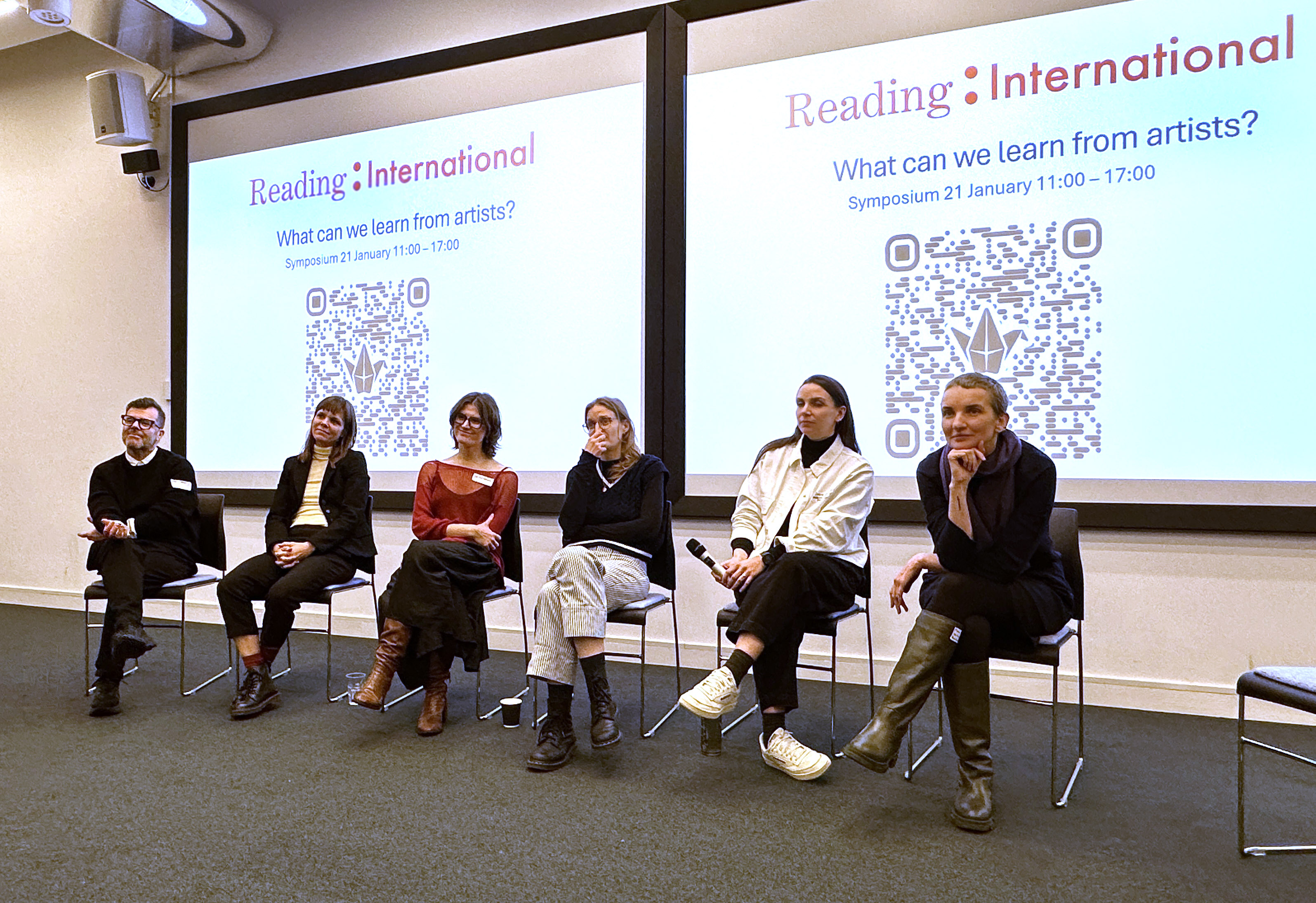
The What Can We Learn from Artists? symposium was organised by Professor Susanne Clausen and formed part of the research and public programme of Reading International, based at the Reading School of Art, University of Reading. The event brought together artists, curators, and researchers from the UK and Europe to share knowledge emerging from artistic practice, particularly in contexts of social, political, and institutional change.
The Reading School of Art played a central role in hosting and shaping the symposium, embedding it within a research culture that values practice-based enquiry, international exchange, and public engagement. The event reflected the School’s commitment to artistic research as a critical method for understanding contemporary crises and for imagining new institutional and civic models.
Speakers and notable moments
The symposium featured contributions from a range of international practitioners working across artistic, curatorial, and institutional contexts.
Alona Karavai (Ukraine), cultural manager and curator, and co-founder of Asortymentna Kimnata, spoke about the emergence of new narratives and vocabularies within art infrastructure shaped by war. She described how artists in Ukraine are increasingly referred to as “civilian artists” and “militarised artists”, highlighting the changing roles and responsibilities artists occupy in times of conflict. Her contribution focused on how artists “perform the gap” and “voice the unspeakable”, offering forms of articulation where language, policy, and representation fall short.
Lea Schleiffenbaum (Germany), art historian and curator working with New Patrons, introduced New Patrons as an organising framework that proposes a form of democracy specific to each commissioning project. She discussed new approaches to public commissioning, memorialising, and the role of memory in public space, emphasising collaborative processes between artists, communities, and mediators.
Cecilie Berndt and Pamela Grombacher (Denmark), co-founders of Juxtapose in Aarhus, reflected on long-term, process-based curatorial practice. Their joint presentation explored collaborative infrastructures and alternative models of organising that resist extractive or outcome-driven frameworks.
Jessie Robertson (UK), curator at Modern Art Oxford, spoke about institutional practice and public engagement, focusing on the role of learning, care, and responsiveness within contemporary art organisations.
Paul O’Neill (Ireland/Finland), curator, writer, and Director of PUBLICS in Helsinki, introduced ideas from his new book focusing on parahosting as a model of institutional thinking. He discussed how parahosting must be continually reconsidered at every level, opening up transformative possibilities beyond existing power structures, including the idea that “paraguests” actively help define the conditions of their stay.
Emerging themes
Across the symposium, speakers returned to shared questions around how artists generate knowledge under conditions of instability, how institutions might learn from artistic methods, and how concepts such as hosting, memory, democracy, and care can be rethought through artistic and curatorial practice. The discussions foregrounded artistic practice as a site for ethical experimentation, collective learning, and institutional reflection.

 Reading School of Art